EPHEMERAL RESOURCES, SCAVENGER ECOLOGY, AND CLIMATE CHANGE
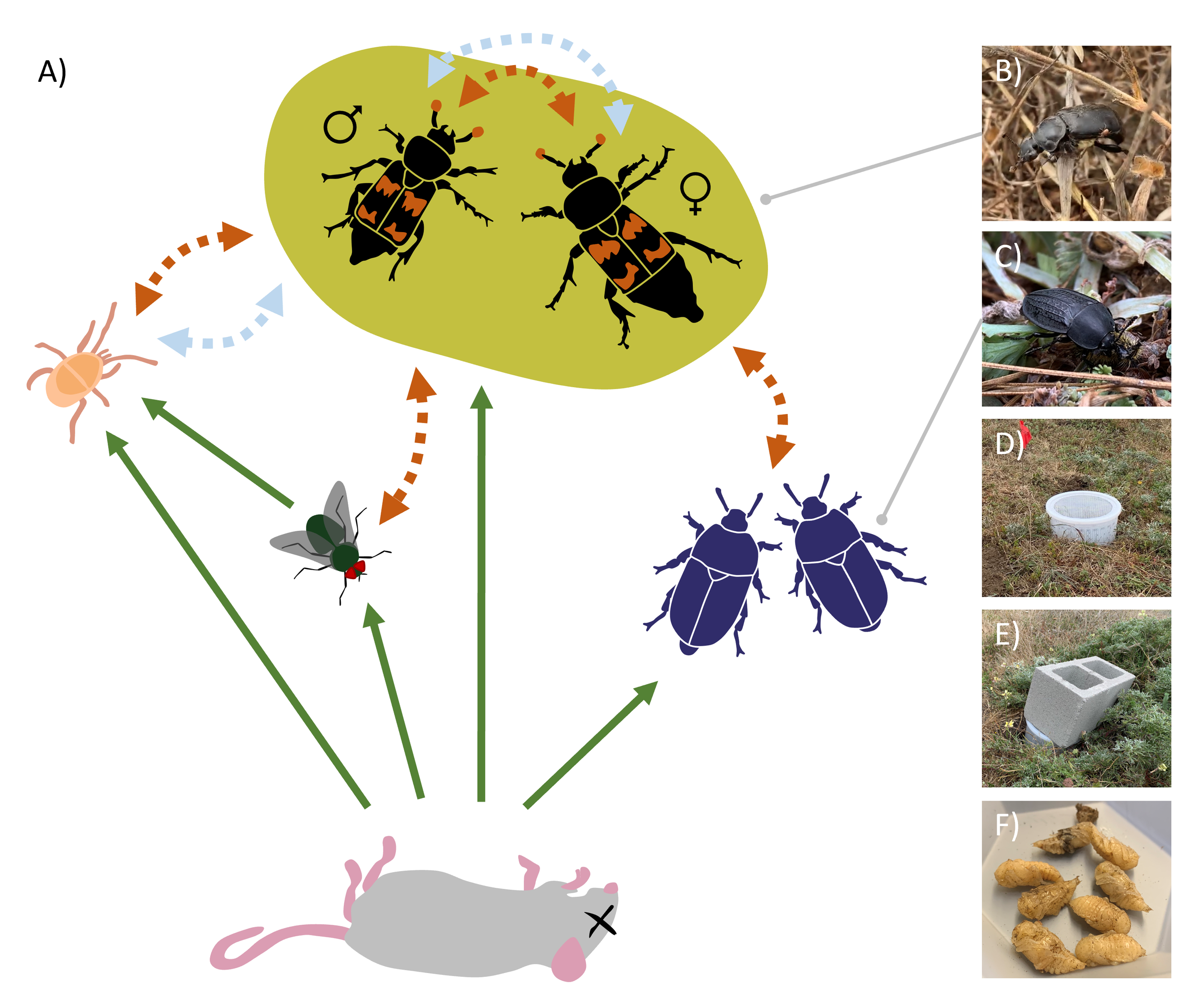
A) A network of burying beetles (top), a carcass resource (bottom), and multiple interacting species (left, a phoretic mite and blowfly; right, a confamilial competitor, Heterosilpha spp.). Straight green arrows represent consumption; double-sided, dark orange dotted arrows represent potential negative interactions; and double-sided light blue dotted arrows represent potential positive interactions. Note that species are not drawn to scale. B) Nicrophorus guttula with a phoretic mite. C) Heterosilpha spp. D) Experimental chamber, halfway submerged in the soil, with a lid made of a layer of both wire mesh and fine mesh. E) A cinder block is placed over experimental chambers. F) Collected pupae from an experimental chamber that had successful reproduction.
Resource availability in space and time is a major structuring force in ecological communities. In my dissertation, I studied organisms that are adapted to use ephemeral and scarce resources. This resource ephemerality and scarcity is especially relevant under climate change, which can directly affect resource availability via shifts in temperature and moisture. These shifts can change the window of resource availability, often decreasing the amount of time a resource is available to consumers.
Burying beetles in the genus Nicrophorus are specialists on ephemeral resources. They rely on small, highly desirable nutrient-rich carcasses to reproduce. Adults will find a small carcass, usually a mammal or bird, and a mating pair will dig underneath it to bury it, protect it from scavenging competitors and decomposing microbes, and prepare it for feeding their offspring. When eggs hatch, both parents will participate in feeding the larvae. These species serve as models for understanding how ephemerality affects reproductive success.
In California, burying beetles are common in coastal environments, where moisture and temperature regimes are shifting under climate change. Fog plays a critical role in the ecology of coastal California but has decreased with climate change. Fog provides both moisture and a cooling effect to large swaths of coastal ecosystems, especially in the summers when the climate would otherwise be warmer and dryer. Because of this, fog could have drastic effects on resource scarcity and ephemerality.
In my first chapter, published in Ecology, I used experimental chambers in the field to test the effects of moisture and competition on burying beetle reproduction. I found that burying beetles reproduce much less often on partially dried carcasses, and that competition from a generalist species of carrion beetle limits number of offspring for reproducing pairs. Additionally, I did a field study that confirmed that carcasses dry out faster with reduced fog, linking shifts in fog regimes to my partially dried carcass treatment.
My second chapter involved a similar field study with experimental chambers, burying beetle pairs, and partially dried carcasses. I tested the effects of leaf litter microhabitat on burying beetle reproduction and survival, finding that leaf litter does buffer the negative effects of carcass dryness on survival.
Finally, in my third chapter, I used experimental chambers in the field to test the effects of a subtle and realistic environmental fog treatment on burial, reproduction, and survival. Most notably, I found that this fog addition treatment significantly increased the number of larvae a pair produced compared to the control.
Together, this work shows that changes in the coastal fog regime could have a profound effect on burying beetle populations. The ability of drier and warmer conditions to exacerbate resource scarcity in space and time is a largely unexplored area in ecology. The results found in this system set the stage for understanding the effects of shifts in abiotic and biotic variables on windows of resource availability and consumer success. Broadly, my dissertation work explores the causes and consequences of resource availability in time, using an obligate scavenger system with ecological relevance to nutrient cycling and the effects of climate change.